
San Bernardino Previous Residents by Era
A useful trail begins by sorting sources by what they can show and when they reach. The table keeps title, assessment, occupancy, structure, and event evidence separate. The ARC deed index has two published coverage descriptions, so both belong in the working notes rather than being silently merged.
| Source | Years it covers | Where held | What it shows |
|---|---|---|---|
| ARC recorder index | 1958-present chain; general page advertises 1925-present | Online index, counter, copy order, or mail | Grantor, grantee, title, date, document number; no web image |
| Recorder microfilm and index books | Pre-1958 by decade | Main Recorder counter | Older party and legal-description links |
| Assessor lot and parcel books | 1895-about 1950 | County Historical Archives, by school district or legal description | Owner or taxpayer and value changes |
| City and criss-cross directories | City 1887-1968; criss-cross 1976-present; exact reverse run not verified | California Room and library catalogs | Listed names and address snapshots |
| Great Registers | 1866-1908 | County Historical Archives, in-house | Historic voter names and, in some years, age, height, physical description, and naturalization |
| Federal census schedules | 1850-1950 public schedules | NARA and library databases | Household members, relationships, ages, birthplace, and neighbors |
| Sanborn fire-insurance maps | Exact local sheet years not verified | Library of Congress collection | Building footprint, use, street name, and structure context, not occupants |
| Historic newspapers and obituaries | Title-dependent | California Room and California Digital Newspaper Collection | Names, addresses, relatives, events, and death notices; verify OCR against the page |
| Building permits | About 1936 onward in county jurisdiction; city start not located | City or county office by historic boundary | Projects, parties, dates, and changes to a structure |
Start with the parcel and deed chain for title questions. Use directories and the census for household clues, maps for the physical setting, and probate or newspapers when a family trail reaches a death or estate. A single absence is not a finding.
Note: Coverage labels come from separate county descriptions, so confirm the applicable date range before treating a gap as evidence.
San Bernardino Deed Index Years
The Assessor-Recorder-County Clerk at 222 W. Hospitality Lane combines related offices, but the databases remain distinct. The ARC official-records index is keyed by document number, date, title, grantor, and grantee. It does not identify ownership by street address. Use Assessor Property Information or Parcel Access to turn a situs address into an APN and assessment name before switching to the recorder's party search.
The general ARC page advertises a 1925-present document search. The detailed property-research guide describes name-chain work as 1958-present and sends pre-1958 work to decade microfilm. Keep both published claims in the log, then ask Recorder-Clerk Services which range applies to the index task at hand.
| Field label | Type | Required | Use or format note |
|---|---|---|---|
| Grantor / Grantee | Party-name text | One search key | Try spelling variants and keep the party role. |
| Document Number | Text | Alternative key | Use an exact recorded identifier. |
| Document Date / range | Date or date pair | Optional | Narrow a broad name search by time. |
| Document Title / Type | Text or category | Optional | Deed, trust, reconveyance, lien, release, or map; the full live list was not exposed. |
| Order Public Official Records | Linked workflow | Not a search key | Starts a copy order; certification and delivery differ. |
The online index is free to reach, but ARC does not display instrument images online under the restriction it cites in Government Code section 7924.205, formerly section 6254.21. Contents can be inspected at the Hall of Records or High Desert Government Center in Hesperia. Online orders carry a 3.5 percent card surcharge; noncertified copies are emailed and certified copies are shipped. A mail request uses the county form, a check or money order, and a named document. ARC says mail returns take one to two weeks, and an express return envelope may help when speed matters. Appointments are strongly encouraged for in-person index work. The schedule effective July 1, 2026 lists $4 for the first recorded page, $1.50 for each later page, $5 per computer-index-copy page, $0.10 per online image file, $3.50 for regular mail, and $29 for priority mail. Maps are purchased only at the San Bernardino Hall of Records. Verify totals against the current ARC fee schedule.
Note: A recorder index can identify parties and instruments, but a street address still needs a parcel match and the document image or copy for stronger conclusions.
San Bernardino Past Owners Backward
The backward deed method follows a seller into the earlier deed where that seller was the buyer. It works only when each party match is checked against the same land description, not just a familiar name.
- Search Parcel Access by situs address. Save the APN, current assessment owner, legal description, and the difference between situs and mailing address.
- Classify the description. An urban parcel may use a tract, subdivision, and lot, such as TRACT NO 2436, LITTLE MOUNTAIN ESTATES, LOT 100. Rural land may use section, township, and range.
- Search the current owner as grantee or buyer in the recorder index. Match the deed title, date, document number, and legal description before calling it the purchase deed.
- Write the grantor, grantee, date, document number, book and page, exact description, and confidence in a ledger. Order or inspect the document when index fields are not enough.
- Search that seller as the earlier grantee. Match the same tract, lot, or land description, then repeat the handoff from seller to prior seller.
- When the trail reaches pre-1958 material, ask the main Recorder for decade microfilm or index books. Resolve the separate 1925-present and 1958-present descriptions by calling Recorder-Clerk Services at 909-387-8306.
A current owner is a present-day working label from the parcel search, not a conclusion about every person at the address. The assessed owner is the name on the assessment roll, which ARC says is not a judicial determination of legal title. A titled party is the person or entity shown in recorded title evidence. Occupants are people connected by a directory, census, obituary, permit, or other household source. One person may appear in one role and not the others.
- Grantor / grantee
- The grantor transfers an interest; the grantee receives it. In a backward search, the seller in one deed becomes the earlier grantee.
- Chain of title
- The linked sequence of recorded transfers that connects a present title claim to earlier parties.
- Legal description
- The tract, lot, section-township-range, or other land description that anchors a parcel when a street form changes.
San Bernardino Previous Residents by Household
Directory evidence answers a different question from a deed. A city directory can place a listed household at an address for a publication year, while a criss-cross volume can read the street numerically when that volume exists. The collection history is available through the San Bernardino Directory Book. Use the volume's own key and record the printed form instead of assuming every shorthand means the same thing.
The National Archives census research portal sets the public schedule context for household comparison.
The census source supplies a household check, not a title record. The latest public federal schedule is 1950 under the 72-year release rule, so National Archives (NARA) schedules are a historical fallback rather than a current resident list.
- Choose a directory year and write the address in every form shown, including directional words, initials, and compound surname parts.
- Read the alphabetical directory entry, then the reverse or criss-cross section if a matching volume exists. Capture the name, household notation, address, page, year, and key.
- Pair that entry with the closest public census year. Compare household members, relationships, ages, birthplaces, and nearby households rather than treating one matching name as proof.
- For the 1890 gap, build a substitute stack from directories, Great Registers, assessor books, deeds, newspapers, probate, and cemetery records.
- Use an obituary or newspaper notice to test relatives, a death date, or a move. Search OCR with full names, initials, spelling variants, and the address, then inspect the page image.
- Mark what is direct, inferred, or unresolved. A directory omission may reflect publication timing, a move, a name change, or an incomplete canvass.
This process can reconnect family lines across years when no single public census or deed states who shared the house.
Note: Directory and census evidence describe historical snapshots; neither should be expanded into a complete list of everyone who occupied a dwelling.
San Bernardino Address History Clues
A situs address is the parcel's physical location. A mailing address is where assessment notices go and may point to an owner elsewhere. The legal description is the more stable bridge when a street form, direction, unit, or number looks different in an older source. Historic maps in the Arda Haenszel California Room can help place San Bernardino's broad early street grid.
San Bernardino may mean the city, the county, the valley, or a postal designation. Nearby Muscoy is unincorporated even when a mailing line uses San Bernardino. Confirm the APN and boundary before sending a city permit request. Countywide ARC, elections, recorder, and Superior Court records cover the city, while city files depend on incorporation and the relevant historic boundary.
No official source located for this research documents a citywide San Bernardino street-renumbering project or a dated list of renamed streets. Do not fill a failed search with that assumption. Compare period maps, directory title pages, criss-cross volumes, and parcel evidence year by year. A word such as North or West may be an address component, and older directories may abbreviate it. Sanborn maps add building footprints, street names, uses, and construction context, but they do not identify occupants. The exact local Sanborn sheet years were not verified. Neither a parcel card nor a reverse directory enumerates every occupant, child, or roommate; utility, DMV, and delivery data are not open substitutes.
San Bernardino House History Access
The County Historical Archives is the official local route for pre-digital people records and county material predating 1958. The posted research hours are 8:00 to 11:30 a.m. and 1:00 to 3:00 p.m., yet the service page currently says the building is closed and directs researchers to email ARC-DLRecArchive@arc.sbcounty.gov. The Arrowhead catalog is named online, while ARC says that database is temporarily disabled.
The archives service and location details are available through the San Bernardino County Historical Archives.
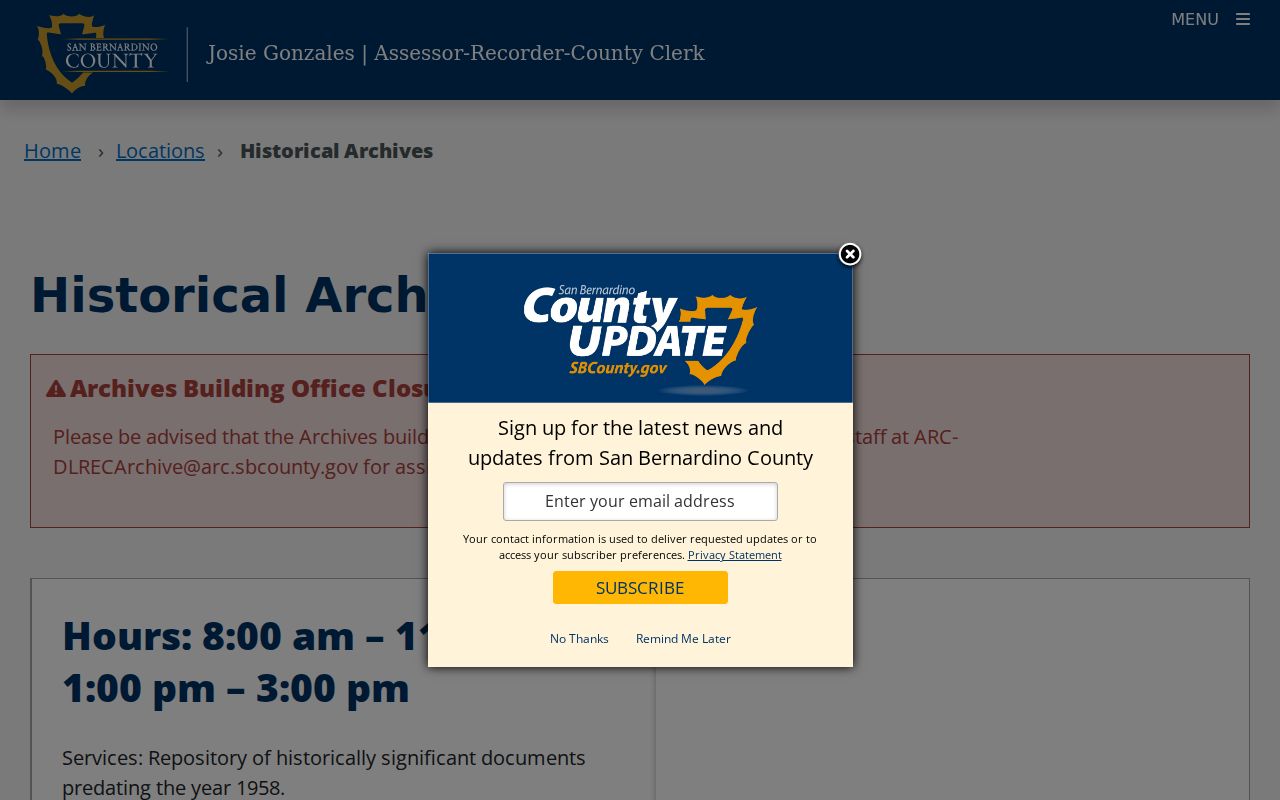
Because the archive building is currently posted as closed, email confirmation is the practical first step before requesting an in-person search.
For printed directories, newspapers, maps, yearbooks, and local-history help, contact the Arda Haenszel California Room at Feldheym Central Library, 555 W. 6th Street. Its listed phone is 909-998-4251, and the posted room hours are Monday and Tuesday 2:00 to 4:00, Wednesday 10:00 to 3:00, Thursday 2:00 to 4:00, and Saturday 2:00 to 4:00. Call before travel. Mail research is listed at $20 per hour or part plus $0.25 per page, with a self-addressed stamped envelope and a precise date. The California State Library genealogy service is a statewide fallback when a local volume is not held.
San Bernardino Past Residents and 1890
San Bernardino County was created from Los Angeles County on April 26, 1853. That date is the local hinge for a past-resident search. County deeds, tax rolls, court files, probate, and marriage records generally follow the new county after its creation. Before it, test Los Angeles County predecessor records, mission or church registers, Mexican-era land evidence, and federal land-claim files. The city was incorporated in 1854, disincorporated in 1863, and reincorporated in 1869, so a city-office series cannot be assumed to run without a break.
The National Archives explanation of the 1890 census loss matters here because most population schedules from that census were destroyed. The 1950 schedule is public, while the 1960 schedule remains closed until 2032.
The 1890 gap makes San Bernardino directories, Great Registers, assessor books, deeds, newspapers, and probate more important for that decade. No official source found in the research documents a courthouse fire that destroyed a defined run of San Bernardino deed or probate books. Treat an unsourced disaster story as a gap, not an explanation.
San Bernardino Probate and Obituary Trails
Probate belongs to the San Bernardino Superior Court, not ARC. The Historical Archives describes probate proceedings from 1853-1926, organized by case and date. Search the Court Access Portal, then request the estate file from the district where it was filed. Petitions, inventories, notices, and orders may identify a decedent, petitioner, heirs, attorneys, property, or mailing address. Sealed and confidential attachments stay out of reach. CAP has limited online data for cases filed before 1998, and older files may be stored off-site.
For a paper file, visit the filing district's Document Control or clerk window, or send a written copy request to that district with the case number and exact documents sought. The court file-access guide says older files can take up to one week to retrieve. Copies cost $0.50 per side; certification is generally $40 per document. A self-addressed stamped envelope helps with mail return. An administrative public-record request under Rule 10.500 is a different channel and does not replace a case-file request.
Newspapers and obituaries can close a household trail when a former resident dies or leaves an estate. The California Room holds the San Bernardino Sun on microfilm from 1894 onward, and the California Digital Newspaper Collection offers searchable historic titles. An obituary can supply relatives and life events; it does not alone prove that a person occupied the address.
San Bernardino Permits and Public Requests
Permits can show what changed between two owners. County permit records begin about 1936, while some cities may have earlier material. A permit may connect an address with an owner, applicant, contractor, architect, project scope, valuation, issue or final date, and inspection milestones. It is evidence of control or improvement, not a complete household roll. Confirm whether the parcel was inside city limits at the time because the City and County offices do not hold the same permit series.
For city-created records, use the San Bernardino Development Services and Building & Safety route, then use the City Clerk's online search or public-record request channel when the record is not posted. A focused request should name a recognizable record, date range, department, address or parcel, permit or project number, and preferred electronic format. The Clerk says the city normally determines within 10 calendar days whether it has disclosable records, with a written extension of up to 14 days for unusual circumstances. That is a determination deadline, not a promise of production. The CPRA does not require the city to answer a research question or create a new list, so request existing permit cards, inspection logs, code summaries, or correspondence.
Note: Recorder and Archives holdings do not replace the city or county office that created a permit or code file.
San Bernardino Previous Residents: Lawful House History
A careful prior-resident trail is a form of local history. It can connect a family line, an estate, a structure, and a block without treating every name in a record as a present resident. For a claim before county formation, start with the official San Bernardino County history and the State Archives county-records guide, then identify the older custodian instead of forcing the claim into a modern index.
The county history source provides the setting for the 1853 handoff.
That context helps route a record search, but it does not prove who lived at a particular address. Keep sources, roles, dates, and confidence levels separate.
Lawful house history. Use previous-resident research for family history, estate and heir work, a property's documentary story, or personal curiosity. A public record does not authorize tracking, threatening, or harassing a living person. Do not treat an absent name as proof of death or a current listing as proof of residence.